
You Don’t Have to Carry It All: Reflections From Our Book Club on “Burnout”
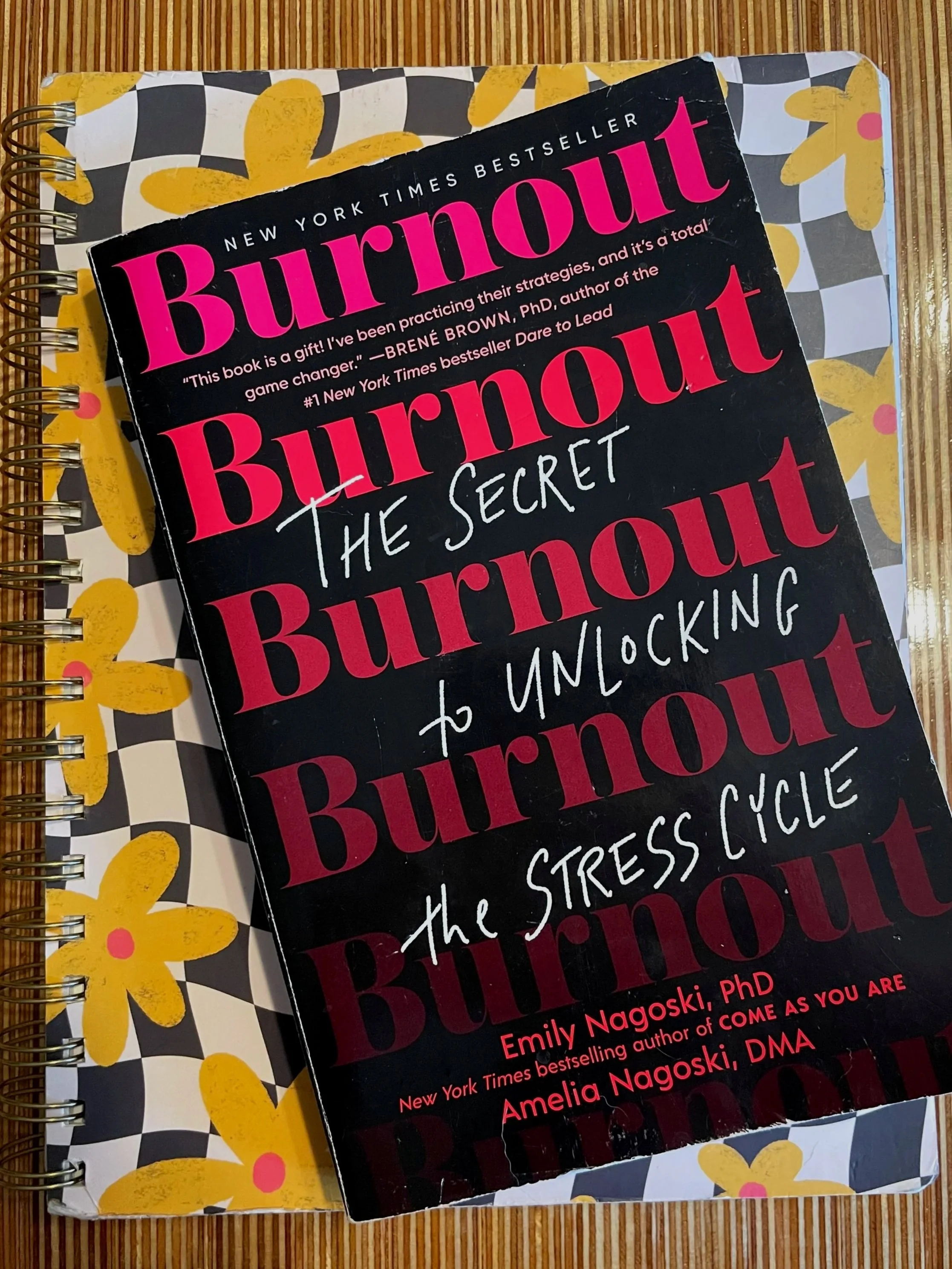
We Had More in Common Than the Book
Saturday morning, nine women showed up to discuss the topic of burnout. Many were delayed by road closures (thank you, Ore to Shore!), most arrived with coffee in hand, and everyone was apologizing.
“I’m sorry I’m late.”
“Is it still okay for me to join this late?”
Even these beginning interactions showed me that I had a lot more in common with these women than simply the need to read a book called Burnout. We were all people-pleasers, givers, and chronic apologizers. We came from different professions, but we shared a common thread: our work asks us to care for other people.
We opened our discussion with vulnerability, each sharing the last time we felt emotionally exhausted. Everyone’s answer was sometime in the last week, many saying it had been the night before.
Stress Isn't the Same Thing as the Stressor
A key concept from the book that stood out to many as “life-changing” was recognizing that the stressor and the stress are two separate things.
We began to see our bodies’ reactions to stressors not as failures or signs of weakness, but as something to tend to.
The stressor might be the difficult conversation, the demanding job, the parenting, the caregiving, or the never-ending to-do list. But even when the stressor is over, our bodies don't necessarily know that the danger has passed.
We can tell ourselves,“I'll relax when things calm down,” only to find that there is always another thing waiting.
So what does it look like to actually complete that stress cycle?
Sometimes, it can be surprisingly small.
A song in the car.
A good laugh.
Moving your body.
Crying.
A 20-second hug.
A moment of connection with someone who makes you feel safe.
These things can sound almost too simple, but I think that's part of what I appreciated about the book.Breaking the cycle doesn't always have to be another thing we add to our already-full list.
And sometimes, the thing we need most is connection.
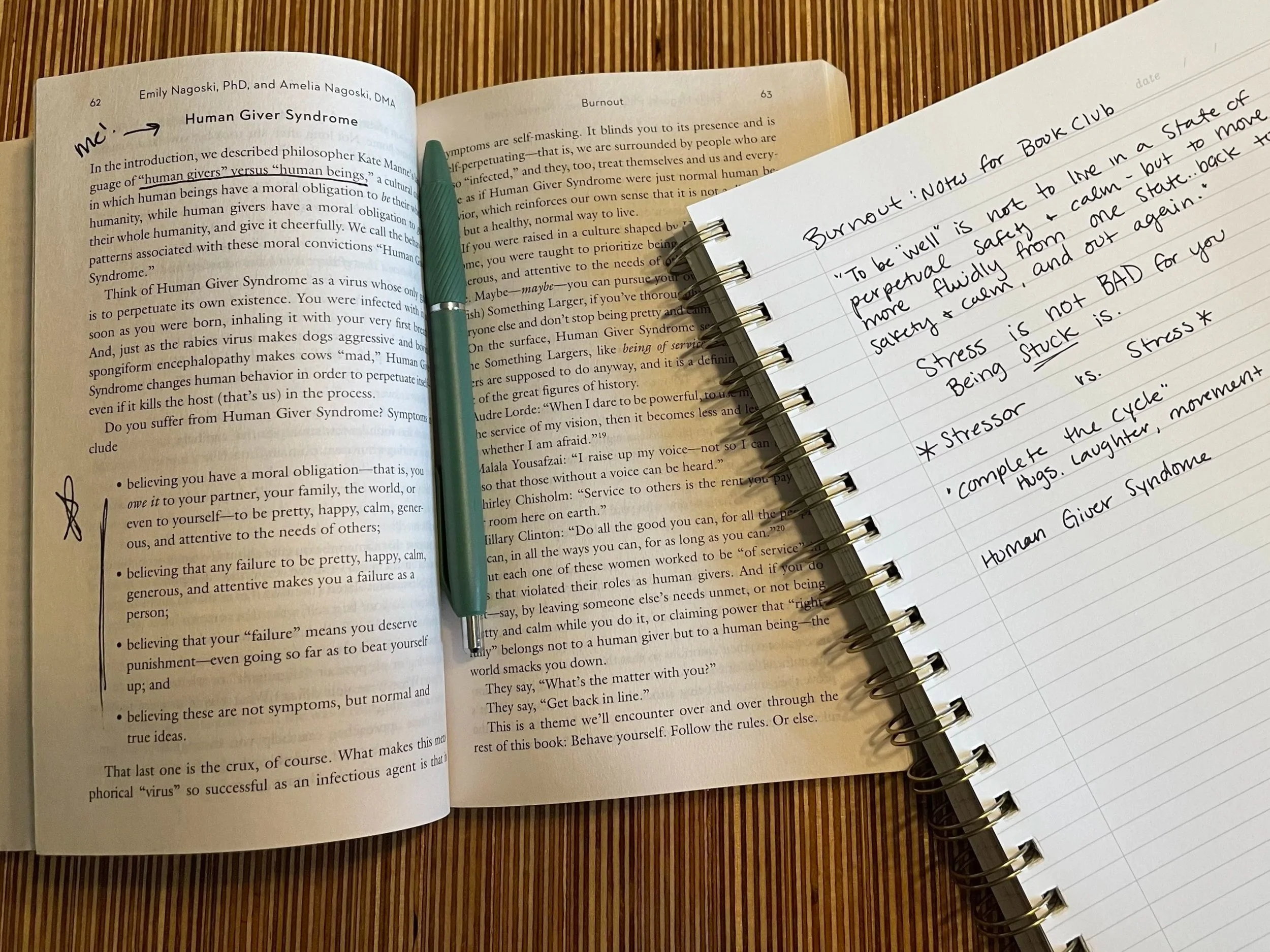
“Your body, with its instinct for self-preservation, knows, on some level, that Human Giver Syndrome is slowly killing you. That’s why you keep trying mindfulness and green smoothies and self-care trend after self-care trend. But that instinct for self-preservation is battling a syndrome that insists that self-preservation is selfish, so your efforts to care for yourself might actually make things worse, activating even more punishment from the world or from yourself, because how dare you?”
— Emily and Amelia Nagoski, Burnout: The Secret to Unlocking the Stress Cycle
Who gets to be your someone?
One conversation that really stayed with me was around the role so many of us play as “the someone.”
The someone who solves the problem.
The someone who remembers.
The someone who eases everyone else's anxiety.
The someone people call when they need help.
The someone who is constantly thinking about what everyone else needs.
But who is your someone?
Who do you feel most like yourself with?
Who can you ask for help?
Who can you be honest with when you're not okay?
There is a particular kind of burnout that comes from always being the person who holds things together. And sometimes breaking that cycle means allowing ourselves to be cared for, too.
During our discussion, we noticed how often we apologize for having needs, taking up space, or receiving support from others.
One insight shared during our discussion was the idea of shifting from saying “sorry” to saying “thank you.”
Thank you for your patience with me.
Thank you for letting me share.
Thank you for letting me take up space in our discussion.
Thank you for letting me still join the group when I showed up late.
It seems like such a small shift, but it changes the story we are telling ourselves. Instead of assuming that our needs, our mistakes, or our presence are an inconvenience to someone else, we acknowledge the other person’s willingness to be there with us.
Another theme that emerged when we shared our stories of emotional exhaustion was how often that exhaustion was connected to feeling a need to be there for others—and then feeling guilty, tired, and burned out when we simply couldn't be there for someone anymore.
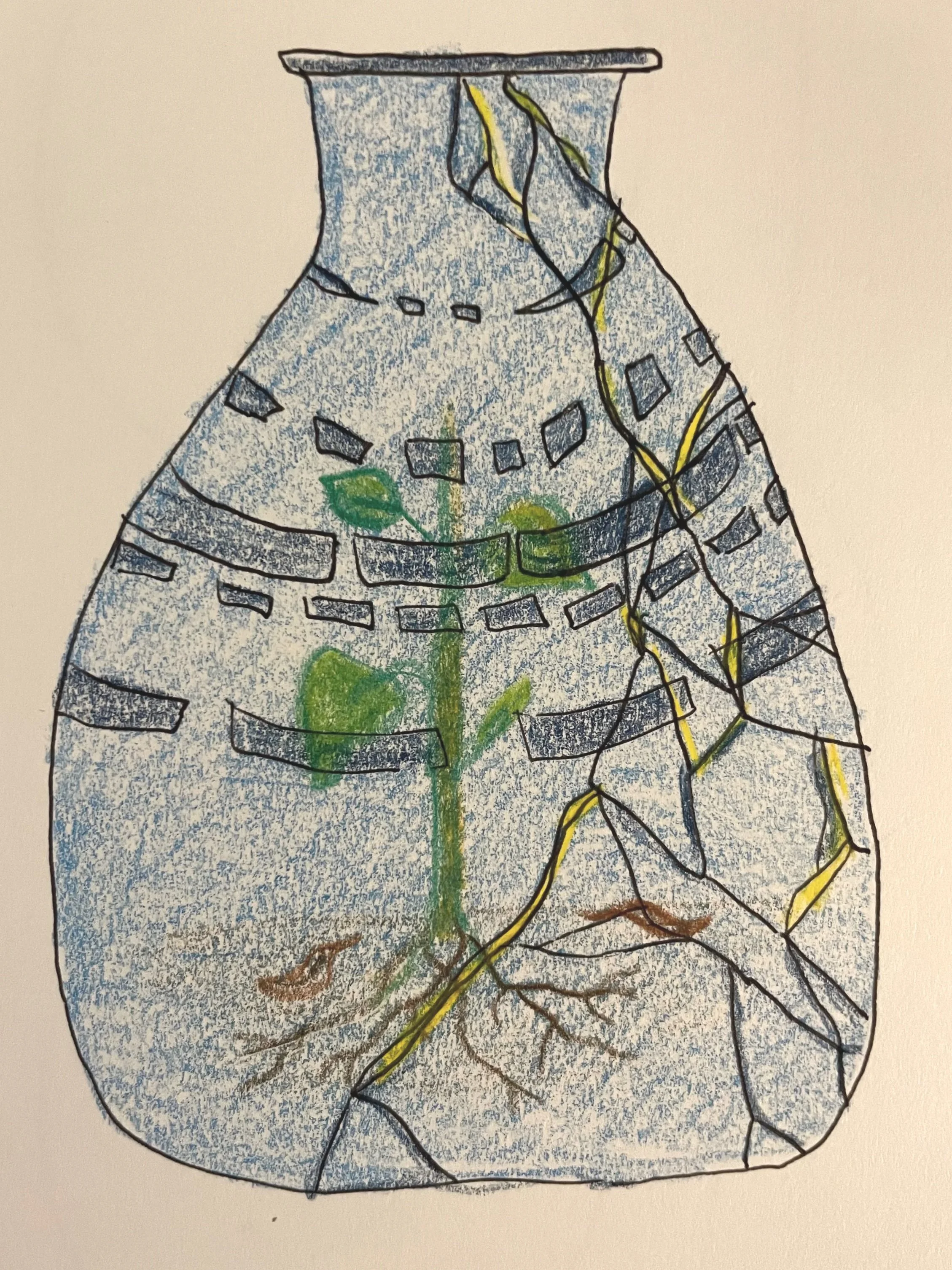
Making room for the “madwoman”
One topic we explored from the book was the idea of the “madwoman” , the inner voice that criticizes us whenever there is a gap between who we are and who the world expects us to be.
We explored the many difficulties we face with the emotion of anger and how we sometimes disconnect from our anger. But, what if we could see anger as a kind of check-engine light rather than something we need to immediately shut down?
What if, instead of shutting anger down, we became curious about it?
What is it trying to tell us?
Where have we been pushing ourselves too hard?
What boundary might need attention?
What need have we been ignoring?
And perhaps most importantly, what would happen if we stopped beating ourselves up?
The Gift of
"You Are Enough"
One quote that lingered with us from the book reads:
"A lot of the time, knowing when to give up comes to us not from rational, explicit cost-benefit analysis... We simply hear the voice inside us saying, 'You've done all you can here. It's time to move on.' Humans, especially women, have an extraordinary capacity to ignore this voice."
— Emily and Amelia Nagoski, Burnout: The Secret to Unlocking the Stress Cycle
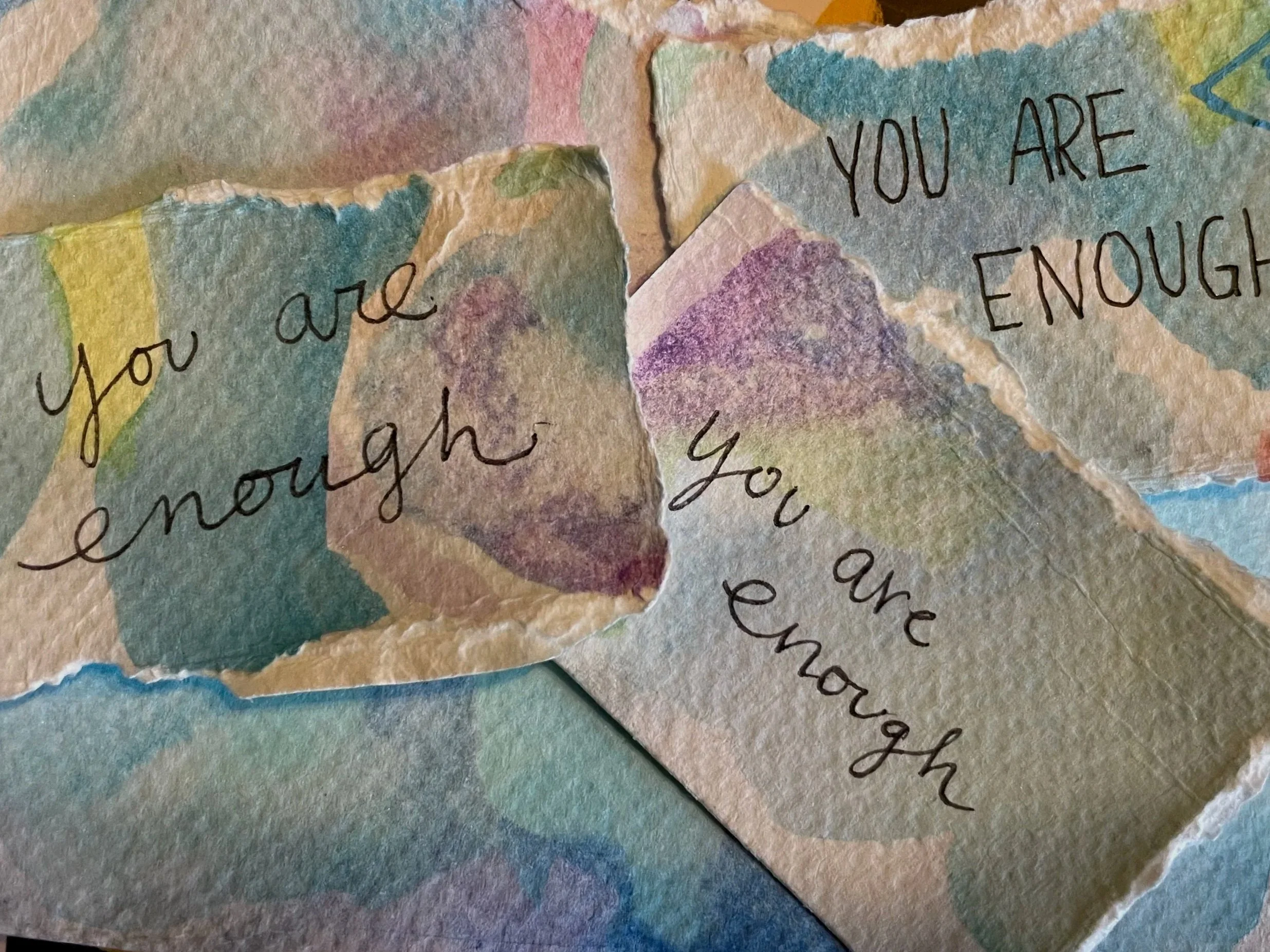
We ended the morning with a simple exercise of offering one another a message inspired by the book:
YOU ARE ENOUGH
This was inspired by a question posed in the book:
What does it feel like when you connect with other “givers” and give them the gift of “You Are Enough”? What does it feel like to receive that same gift?
There was something especially meaningful about ending our conversation this way.
After spending the morning talking about all the ways we give, carry, fix, remember, help, and care for others, we ended by offering one another something without asking anything in return.
YOU ARE ENOUGH
Because ultimately, I don't think burnout is something we can simply “fix” by becoming better at self-care.
Sometimes we need to change how we relate to stress. Sometimes we need boundaries. Sometimes we need rest. Sometimes we need to ask for help. We need to accept our humanness. And sometimes we simply need other people who understand.
Maybe that's part of what made this book club so meaningful to me.
We came together to talk about burnout, but we also created a small space where we didn't have to carry it alone.
What's next?
We're planning another book club discussion in a couple of months, and I'm already looking forward to gathering again. We have a list of books to choose from, and I'm seeing what feels like the right fit for us next.
We're also working on something a little different: Reignite, a therapist-led art therapy group designed to help you reconnect with your inner spark after burnout.
We'll incorporate some of the ideas we talked about during book club—including stress-cycle completion, body awareness, connection, boundaries, self-compassion, and creative expression through art therapy.
Because maybe the goal isn't to figure out how to do more without burning out.
Maybe it's to ask: What would it look like to feel like ourselves again?
